
Running a Sex Offender Check in Clarke County
The Virginia Sex Offender and Crimes Against Minors Registry is the main public channel for a Clarke County sex offender check. Virginia State Police manages the free portal and updates it each business day. Searchers may look for a specific person, examine registrants tied to a ZIP code, or search around a street address. Official descriptions say the location tools can include people who reside, work, or attend school in the chosen area. Start with the narrowest reliable facts available, then open the profile rather than treating a result-list name as a confirmed identity.
Clarke County does not publish a separate local registry list or map. The Sheriff's Office handles local registration updates, while VSP publishes the public profiles. For a cross-state search, the federal National Sex Offender Public Website can add records supplied by other jurisdictions. It does not replace the Virginia portal for radius work in Clarke. Anyone who cannot access the online registry can contact the VSP Sex Offender Registry unit or the Clarke County Sheriff for the appropriate official channel.
Clarke County Address Registry Search
A location search answers a different question from a name search. The VSP registry supports a ZIP search and an address-radius mode described in official materials as spanning one quarter mile through five miles. That range can help a Clarke County resident review a home, school, workplace, or another familiar point. It should not be used to infer where a person is at a given moment. A registered home, work, or school address is a reported registry fact, not live location data.
The exact labels and selector choices can change because the live registry interface did not render during the research review. Follow the controls shown by VSP, read the portal's terms, and avoid assuming that a field is mandatory unless the current screen says so. The VSP portal is updated on business days, so a newly reported change may not appear at once.
Searching the Virginia Sex Offender and Crimes Against Minors Registry
VSP offers person and place-based routes in one official system. A careful Clarke County registry search begins by choosing the mode that matches the known facts and ends by reading the full public profile. Search controls may change, but the functions below are verified in VSP materials.
- Open the VSP registry and review its current conditions of use.
- Choose a person search, ZIP search, or address-and-radius search based on the facts in hand.
- Compare the result with the profile's aliases, age, photo, addresses, and conviction information.
- Open the full profile, note its status, and use Track Offender if change alerts would be useful.
| Field Label | Type | Required | Notes |
|---|---|---|---|
| Name/person search | Text mode | Not specified | Locates a specific public profile. |
| ZIP | Text | Depends on mode | Finds people residing, working, or attending school in the ZIP. |
| Address | Address input | Depends on mode | Provides the center point for a local radius search. |
| Radius | Selector | Depends on mode | Official descriptions support ranges from 0.25 to 5 miles. |
| Track Offender | Profile action | No | Sends email notice when a home, school, or work address changes. |
Search results support awareness, not a finding that anyone has broken a law. Confirm details against the complete VSP profile and contact the proper office when a status or address appears inconsistent.
NSOPW and Clarke Registry Limits
The National Sex Offender Public Website combines registry information from states, territories, and participating tribes. Its search fields include first and last name, county, city or town, as many as five ZIP codes, state or territory, Indian Country, and an address-distance mode. That makes it useful when a person may have ties outside Virginia or when the search area crosses a state line near Clarke County.
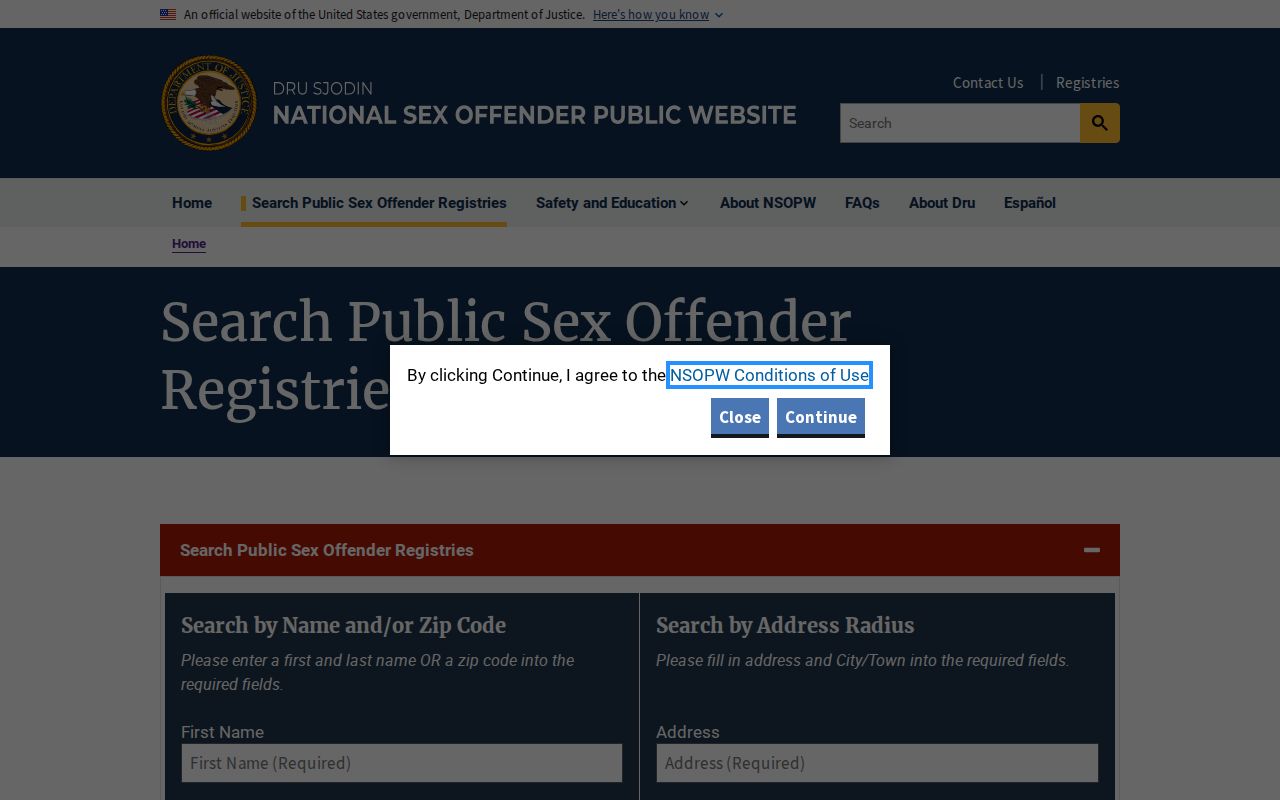
There is an important limit. NSOPW says Virginia does not supply geographic coordinates for its records to the national system. A national radius search may therefore miss Virginia geography even when the underlying VSP profile exists. Use NSOPW as the cross-state layer, then return to the VSP registry for an address-radius review within Clarke County.
What a Registry Profile Shows
Virginia Code § 9.1-913 defines the core public profile. It includes facts meant for identification and public safety, but it does not expose the whole registration packet. A full nonpublic file may contain a date of birth, Social Security number, fingerprints, palm prints, DNA, electronic identifiers, vehicle details, and proof of residence. Those items should not be mistaken for routine public fields.
| Name and Aliases | The registrant's published name and known aliases support identity comparison. |
|---|---|
| Photo and Age | A current public photo and age help distinguish similar names. |
| Current Addresses | The profile may show home and work addresses plus a higher-education institution attended. |
| Conviction | Conviction date, locality, and a brief description of the qualifying offense are public. |
| Public-Safety Status | VSP may add authorized facts, including wanted-for-failure-to-register status. |
| Nonpublic Details | Identifiers, biometrics, DNA, and some vehicle or electronic data remain outside the routine public profile. |
A profile is not a court file. To examine the charge history, orders, or disposition behind a Clarke County listing, use the official court record identified by the conviction locality. Registry fields also should not be read as proof of a new offense.
Clarke County Offender Registration
Registration takes place through local law enforcement where the person resides. In Clarke County, call the Sheriff's Office at 540-955-5152 before going to 100 N. Church St., Berryville, VA 22611. No official county page publishes fixed registry appointment hours or a registry fee. Calling first confirms when the staff member who handles registration is available and what documents are needed.
The initial SP-236 packet includes a ten-print fingerprint card, a palm card, and a photo. SP-236A is used for reregistration and includes thumbprints. A residence change uses SP-236 with a new ten-print card. Virginia generally requires residence, work, and vehicle changes to be reported within three days. Online identifier changes carry a much shorter 30-minute rule. These intake records support VSP's public system, but the Sheriff's Office does not replace the VSP public search.
The Virginia State Police forms page collects the official registration and notification forms used in this process.
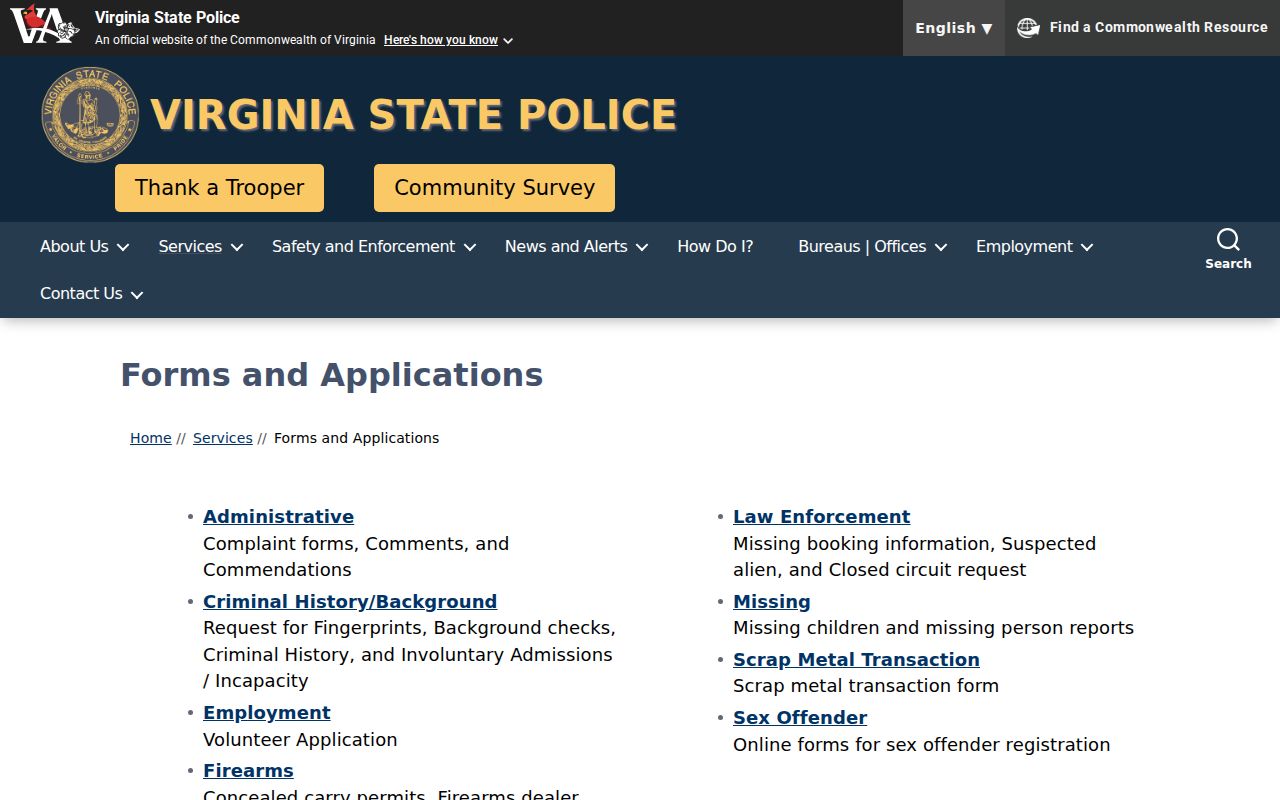
The form hub is the safer source for a current packet than an old downloaded copy because VSP can revise instructions and editions.
Registration Requirements and Levels in Virginia
Virginia ties verification and possible termination to the registration category. The 15-year and 25-year points for eligible Tier I and Tier II cases are not automatic end dates. They are the earliest points at which an eligible person may petition, and the court must make the required findings. Confinement pauses the running period.
| Level / Tier | Duration | Verification Frequency |
|---|---|---|
| Tier I, one eligible offense | Petition no earlier than 15 years; court approval required | Annually in the birth month |
| Tier II, one eligible offense | Petition no earlier than 25 years; court approval required | Annually in the birth month |
| Tier III, murder, or former § 18.2-67.2:1 | Lifetime; no ordinary termination route | Quarterly at three-month intervals |
| After a failure-to-register conviction | Underlying duration remains, with added penalties | Tier I/II twice yearly; Tier III monthly |
A petitioner must meet the statutory conditions, which include treatment, counseling, and restitution requirements, and persuade the court that the person is no longer a public-safety risk. People with two or more registrable offenses and those in Tier III or murder categories are not eligible for the ordinary termination route.
Clarke County Registry Change Alerts
Virginia offers two distinct notice tools. The Track Offender action on a public profile provides email notice when the listed home, school, or work address changes. It is person-specific and starts from the profile. SP-285 is different: it permits mailed notification for a registration or reregistration in the same ZIP code or a contiguous ZIP code.
Choose the tool that fits the question. Profile tracking follows one listed person. ZIP notification covers a defined area. Neither tool promises a real-time alert, and neither should replace emergency reporting. The public registry's business-day update cycle also means a valid change may take time to appear.
Reporting Clarke Registry Noncompliance
A missing person, unexpected address, or old profile detail is not proof of a registration crime. Record the public profile and the fact that appears inconsistent, then send the concern to an official channel. VSP's Sex Offender Registry unit accepts reports at 804-674-2825 and sor@vsp.virginia.gov. The Clarke County Sheriff's nonemergency line, 540-955-1234, is the local route. Use 911 only for an immediate emergency.
Virginia Code § 18.2-472.1 sets penalties for failure to register. Enforcement belongs to law enforcement and the courts, not members of the public. A clear, fact-based report helps officials assess the entry without exposing a household to threats or confrontation.
Lawful Use and Community Notification
Registry information supports personal, family, and community safety planning. It can help a Clarke County resident understand a listed address, follow a profile change, or identify the right official office for a concern. It does not authorize confrontation, threats, intimidation, or harassment. Reasonable distribution is not automatically harassment under Virginia law, but conduct and context matter.
Misuse is a crime. Virginia Code § 9.1-918 bars unauthorized use and use intended to intimidate or harass. A willful violation is a Class 1 misdemeanor.
Public suspicion does not establish a registry violation. Law-enforcement officers and courts assess compliance under Virginia law, while residents can use the official reporting channels without confronting a registrant or household.